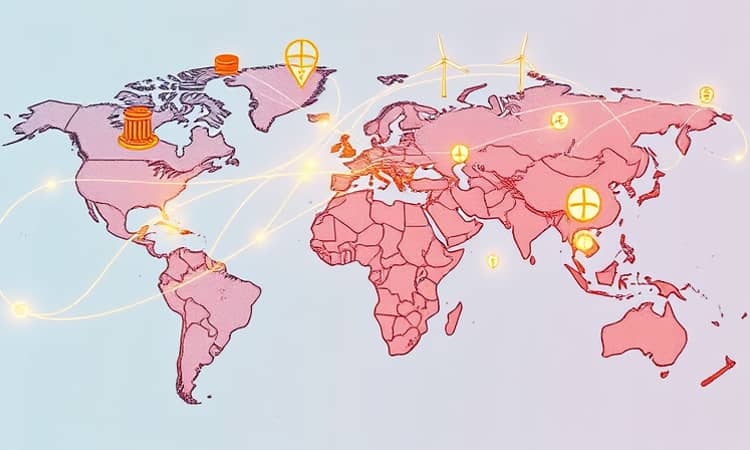
In an era of shifting economic tides and accelerating innovation, investors are seeking opportunities beyond their home shores. Global investing involves allocate assets beyond domestic markets, spanning international stocks, bonds, and sectors like data centers and renewables. Recent trends underscore why diversifying internationally is no longer optional but essential for building resilient portfolios.
Introduction to Global Investing
Global investing means looking past U.S. equities to include markets across North America, Europe, Asia, and emerging regions. In 2025, non-U.S. equities driven by policy reforms and earnings outperformed American markets, reflecting a shift where emerging markets posted a 17% earnings growth projection for 2024–2026 versus 12% in the U.S. This expansion offers investors novel themes, from renewable energy development to next-gen semiconductor facilities in Asia, harnessing trends that domestic allocations alone cannot capture.
Current Global Investment Landscape
The latest data from 2025 reveals a 14% increase in global foreign direct investment (FDI), reaching $1.6 trillion. However, when excluding financial centers, real investment grew just 5%, underscoring fragility in underlying economic activity. Developed economies led the surge with a 43% rise to $728 billion—driven by a 56% boost in EU flows—while developing regions saw a 2% decline to $877 billion, still holding a 55% share of global FDI.
UNCTAD warns that headline numbers mask uneven recoveries, emphasizing the importance of focusing on sustainable real investment. In a complex environment with AI infrastructure projects and renewable energy funding diverging, investors must navigate nuanced regional dynamics to identify genuine value.
Benefits of International Diversification
- Risk reduction via non-correlated markets: Global holdings can offset domestic downturns, smoothing volatility through differing economic cycles.
- enhanced growth from unique sectors: Access high-growth industries like Asian technology, Latin American resources, and European renewable projects.
- currency diversification deters inflation: Multi-currency assets hedge against home currency weakening, protecting real returns.
- portfolio resilience against domestic shocks: Historical data shows international allocations can reduce drawdowns during U.S. recessions by up to 65%.
Risks and Challenges
- increasing correlations limit diversification: During global sell-offs, markets move more in sync, reducing risk buffer.
- Currency fluctuations can erode gains—while a weak dollar in 2026 may boost foreign returns, sudden reversals pose threats.
- Geopolitical tensions and policy uncertainty add volatility, especially in tariff-exposed sectors where project volume dropped 25%.
- Concentration risk in AI and data centers, which represent $270 billion or 20% of greenfield investments, can lead to overexposure in a single theme.
Sector and Regional Hotspots
Data centers and semiconductor facilities led global project growth in 2025, rising 35% in investment value. Key players include France, Korea, Brazil, India, and the U.S., reflecting a broad geographic distribution. Conversely, renewables and traditional infrastructure projects saw declines of 10%–16% in project finance as developers faced tighter budgets and policy shifts.
Emerging markets like Brazil, China, and Mexico offer compelling upside, backed by structural reforms and population-driven demand. In Europe, attractive valuations and bank sector recovery—especially in Germany, France, and Italy—present opportunities as deglobalization trends favor regional supply chains. Southeast Asia, particularly India, Thailand, and Malaysia, remains a semiconductor growth engine, combining workforce availability with supportive industrial policies.
2026 Market Outlook
Economists forecast global GDP growth of 2.8% in 2026, slightly above the 2.5% consensus, with the U.S. expected to expand at 2.6%. Equity markets face a higher bar as investors scrutinize AI capital intensity, while deglobalization could shift leadership toward Europe and emerging markets. Despite a 35% probability of a global recession, diversification into non-U.S. markets may mitigate downside risk and capture resilient growth pockets.
Practical Strategies for Investors
- Allocate complementarily to domestic holdings: International positions should enhance rather than replace core U.S. allocations, maintaining strategic balance.
- Focus on undervalued emerging markets and developed ex-U.S. equities, where price-to-earnings multiples remain below historical averages and earnings growth outpaces domestic peers.
- use global ETFs and bonds for cost-efficient exposure, reducing individual security risk and simplifying currency hedging through broad baskets.
- manage currency risk effectively: Consider selective hedging or local-currency bonds to balance currency impact against yield opportunities.
As U.S. AI-driven sectors accounted for roughly 70% of 2025 equity returns, the need to rebalance amid U.S. AI dominance becomes clear. Shifting a meaningful portion of new capital into international markets can unlock potential in underappreciated regions that have outperformed cyclical downturns.
Global investing is not devoid of challenges, but by combining robust analysis with disciplined portfolio design, investors can build a resilient foundation that navigates uncertainty, captures growth, and sustains wealth over the long term.
Embracing diversification beyond borders opens doors to new industries, policy-driven reforms, and economic engines that complement domestic strengths. With a strategic, informed approach, expanding your portfolio internationally can transform risk into opportunity and guide you toward a more stable and prosperous financial future.